
Pump Mate
What pump and motor do I need?


One-time purchase; price shown in the store.
Pump sizing and hydraulics for field and design work: power and motor size, total dynamic head, pipe and fitting losses, NPSH available, and pump curves. Core calculations work offline, in SI or imperial units.
Power and motor size
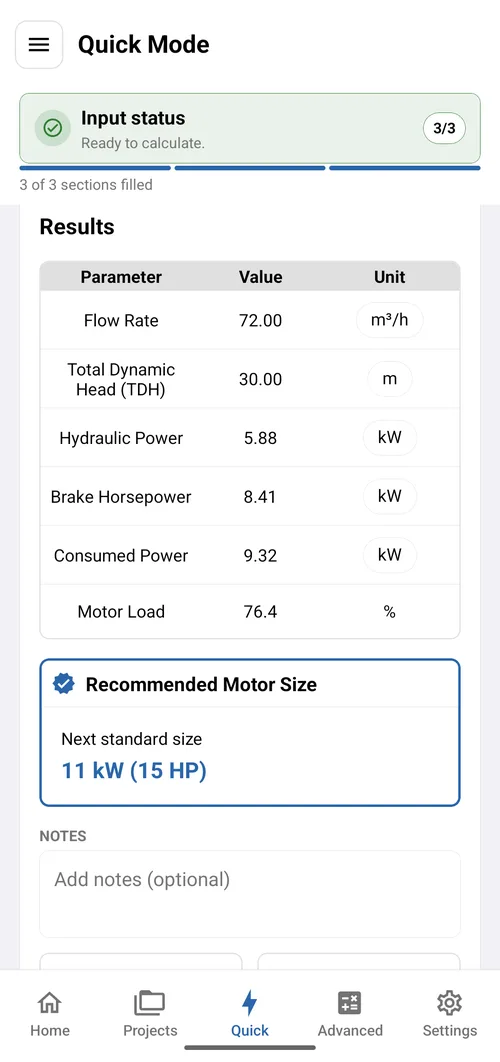
Hydraulic power is P = ρ · g · Q · H. Brake power divides it by pump efficiency. The motor is the next standard size at or above brake power plus a 15% margin, from the metric (kW) or imperial (HP) motor series. Quick Mode runs this from flow, head and fluid density.
Total dynamic head
Static head is the level difference plus the pressure difference between the two ends of the system, converted to head with the fluid density. Suction and discharge losses are added to it to give total dynamic head.
Pipe and fitting losses
Straight-pipe loss uses the Darcy–Weisbach equation with the Churchill (1977) friction factor, which covers laminar, transitional and turbulent flow. Fittings add a loss of K · v²/2g from the K values you enter. Default roughness is provided for carbon steel, stainless steel, HDPE, PVC and copper.
NPSH available
NPSHa is a Bernoulli balance from the liquid surface to the pump: atmospheric pressure (from the pump elevation, standard atmosphere), plus any gauge pressure on the vessel, minus vapor pressure, plus static head, minus suction losses. Compare it with a curve’s NPSHr to see the margin.
Intake submergence
Minimum submergence is S = D(1 + 2.3·FD), where FD = v/√(gD) is the Froude number at the intake, the ANSI/HI 9.8 intake guidance, shown next to the submergence you have available.
Pump curves
Overlay a pump curve on your system curve, and scale it for a new speed or impeller trim with the pump affinity laws. Pump Mate Pro adds the full curve library with H–Q, efficiency, power and NPSHr data, plus slurry head-loss and limiting-deposit-velocity calculations and a pump measurement tool that works out head and NPSHa from nozzle pressure readings.
Free and Pro
The core calculators are free. Pump Mate Pro is a one-time purchase that adds the full professional curve library, Selection Assistant verdicts, pump comparison, professional PDF reports, slurry calculations, unlimited projects and unlimited calculation history.
Preliminary engineering
Use results for screening and preliminary engineering. Verify final decisions against project criteria, manufacturer data and qualified review.
Methods and sources
| What the app calculates or shows | Method or data | Reference |
|---|---|---|
| Hydraulic power, brake power and motor size | P = ρ·g·Q·H; brake power divides it by pump efficiency. The motor is the next standard size at or above brake power plus a 15% margin. | Built-in metric (kW) and imperial (HP) motor series. No published reference is cited. |
| Straight-pipe friction loss | Darcy–Weisbach, with one explicit friction factor across laminar, transitional and turbulent flow. | Churchill (1977). |
| Fitting losses | K·v²/2g, from the K values you enter. | The K values are yours. The in-app guide points to Crane Technical Paper 410 and Hydraulic Institute data as usual sources. |
| Default pipe roughness | Carbon steel 0.045 mm, stainless steel 0.015 mm, HDPE 0.01 mm, PVC 0.0015 mm, copper 0.0015 mm. | Built-in defaults you can change. No published reference is cited. |
| NPSH available | Bernoulli balance from the liquid surface to the pump. Atmospheric pressure comes from the pump elevation. | Standard atmosphere: 101,325 Pa and 288.15 K at sea level, 6.5 K per km. |
| Minimum intake submergence | S = D(1 + 2.3·FD), with the Froude number at the intake. | ANSI/HI 9.8, Rotodynamic Pumps for Pump Intake Design. |
| Pump curve at a new speed or impeller trim | Pump affinity laws. | Standard affinity relations. No published reference is cited. |
| Operating region relative to best efficiency point | Preferred and allowable operating regions. | ANSI/HI 14.3-2024, §6.1. |
| Viscosity correction of pump performance | Correction factors for flow, head and efficiency, for 1 to 3000 cSt. | Hydraulic Institute 9.6.7-2010, Effects of Liquid Viscosity on Rotodynamic Pump Performance. |
| Pump measurement from nozzle pressure readings | Total head and NPSH available from suction and discharge readings. | Hydraulic Institute Pump Fundamentals: System Curves (Eqs. 1.A.3–1.A.6) and Pump Principles (Eq. 1.D.6). |
| Slurry mixture viscosity (Pro) | Relative viscosity of a Newtonian suspension. | Thomas, D.G. (1965). J. Colloid Sci. 20:267–277. |
| Slurry limit deposit velocity (Pro) | The larger of two independent correlations. | Oroskar, A.R. and Turian, R.M. (1980). AIChE J. 26(4):550–558. Wilson, K.C. and Judge, D.G. (1976). Proc. Int. Symp. Freight Pipelines. |
| Slurry head loss (Pro) | GIW four-component model at and above the recommended minimum velocity; equivalent-fluid Darcy–Weisbach as a screening fallback; Durand–Condolios as a comparison. Below the limit deposit velocity no automatic head loss is given. | Sellgren and Wilson (2007); GIW, Slurry Transport Using Centrifugal Pumps, 4th ed. (2023). Durand, Condolios and Gibert (presented 1952, published 1953). |
| Slurry pump derating (Pro) | Head and efficiency reduction from the standard chart; a screening correlation when the chart inputs are missing. | ANSI/HI 12.1–12.6 (2021), §12.3.2.7. |
| Pipe dimensions | Outside diameter, wall thickness and inside diameter by size and schedule. | ASME B36.10M and ASME B36.19-2022 (steel and stainless); ASTM D1785-2021a (PVC); ASTM B88-2022 (copper tube); ASTM F714 (HDPE). |
Privacy
- Account
- None. The app creates a pseudonymous identifier automatically.
- Your calculations
- Stay on your device.
- Usage analytics
- Off until you opt in.
- Crash reports
- Sent, with content redacted.
- Purchases
- Pump Mate Pro, through RevenueCat and the store.