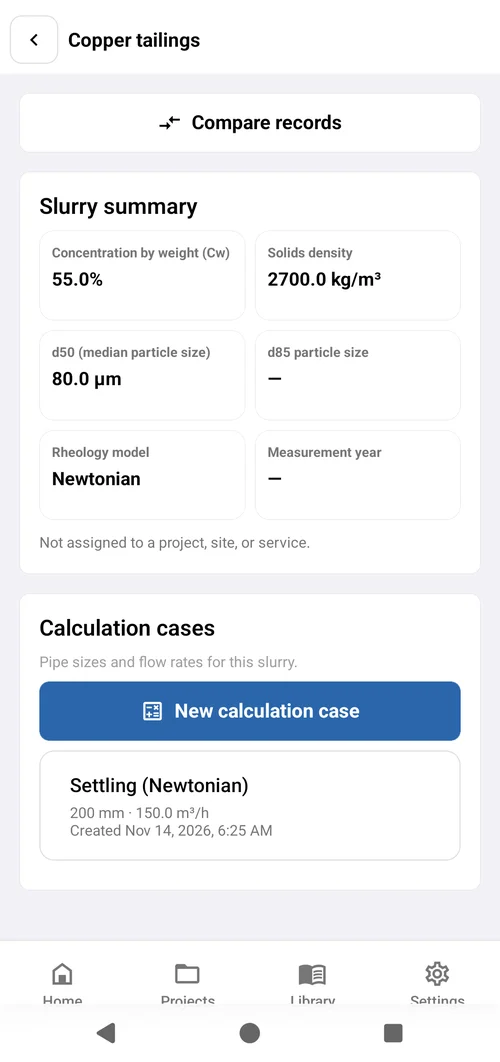
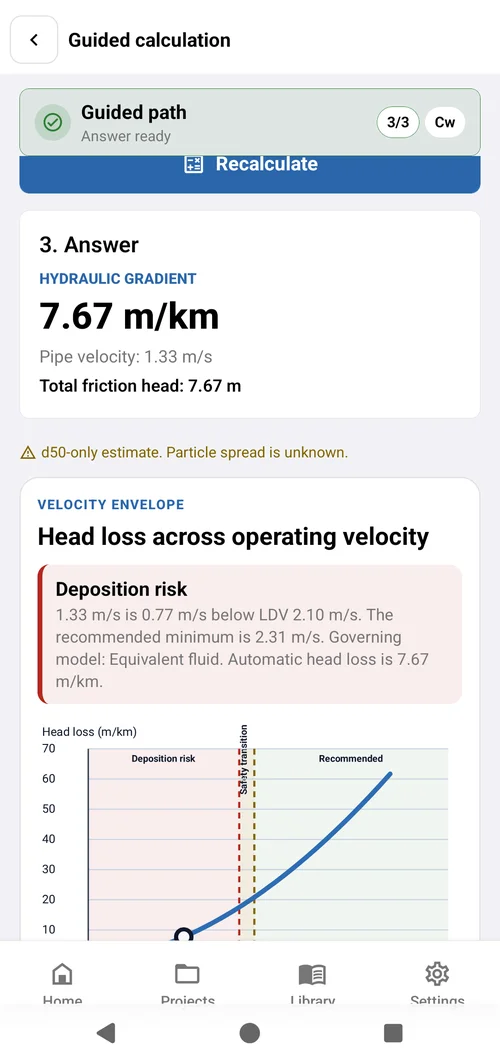
Example screen from a release build, showing a sample record; actual appearance may vary.
A private, offline engineering logbook for mining-slurry characterization and indicative hydraulic calculations, with model-applicability warnings, source-cited references, and PDF/CSV exports that preserve the evidence context. Verify results against project standards and obtain expert review before design.
Project → Site → ServiceSettling & head lossReference librarySI & imperialJSON backup
Methods and sources
What the app calculates or shows
Method or data
Reference
Mixture viscosity
Relative viscosity of a Newtonian suspension, when no measured value is entered.
Thomas, D.G. (1965). J. Colloid Sci. 20:267–277.
Limit deposit velocity
The larger of two independent correlations.
Oroskar, A.R. and Turian, R.M. (1980). AIChE J. 26(4):550–558. Wilson, K.C. and Judge, D.G. (1976). Proc. Int. Symp. Freight Pipelines.
Settling slurry head loss
GIW four-component model at and above the recommended minimum velocity; equivalent-fluid Darcy–Weisbach as a screening fallback; Durand–Condolios as a comparison. Below the limit deposit velocity no automatic head loss is given.
Sellgren and Wilson (2007); GIW, Slurry Transport Using Centrifugal Pumps, 4th ed. (2023). Durand, Condolios and Gibert (presented 1952, published 1953).
Bingham plastic slurries
Buckingham–Reiner in laminar flow; Metzner–Reed in turbulent flow.
Buckingham, E. (1921). ASTM Proc. 21:1154. Metzner, A.B. and Reed, J.C. (1955). AIChE J. 1(4):434–440. Hedström, B.O.A. (1952). Ind. Eng. Chem. 44(3):651–656.
Herschel–Bulkley slurries
Rabinowitsch–Mooney in laminar flow; Metzner–Reed in turbulent flow.
Metzner, A.B. and Reed, J.C. (1955). AIChE J. 1(4):434–440.
Pump derating
Head and efficiency reduction from the standard chart; a screening correlation when the chart inputs are missing.
ANSI/HI 12.1–12.6 (2021), §12.3.2.7.
Reference library
Twelve example slurries. Each entry names its own source and carries a disclaimer.
Among them: Wilson, Addie, Sellgren and Clift (2006); Paterson (2004); Cooke (2007); Slatter (1994); Abulnaga (2002); Jacobs (1991); Thomas (1976); Wasp, Kenny and Gandhi (1977).